
Guilford County Court Records After Arrest
After a Guilford County jail arrest, two public record streams may exist. The jail stream is the booking and custody record: arrest date, booking agency, holding facility, primary charge, bond, and sometimes court date. The court stream is the case record: case number, filed charges, hearings, dispositions, judgments, and payment information. The two are connected, but they are not the same record.
For custody and booking fields, use Guilford County jail inmate records. For booking photos, use the Guilford County jail mugshots page and official P2C channels. For court records after a jail arrest, use the North Carolina court tools and the Guilford County clerk's office because the court record is controlled by the Judicial Branch and the prosecutor-filed case.
Search Court Records After Guilford Arrest
The North Carolina eCourts Portal is the online starting point for many case searches. The North Carolina Judicial Branch also says criminal case information can be accessed at a public self-service terminal at a clerk of court's office in any county. The terminal can search by defendant name, case number, or victim/witness name. Paper files may be accessed through the clerk's office in the county where the case is located, with copies available for a fee.
- Search the P2C jail record first if the arrest is recent, and record the full name, arrest date, charge, court date, and docket number if shown.
- Open the NC eCourts Portal and search by defendant name with Guilford County selected when filters are available.
- Use a case or docket number from P2C, court paperwork, or citation records when a name search returns too many results.
- Open the case record and review each charge, hearing, bond condition, and disposition field separately.
- Use a clerk's public terminal or clerk file request if Portal results are incomplete, older, or restricted.
| Field Label | Type | Required | Notes |
|---|---|---|---|
| Name search | Text | Optional | Search by party or defendant name where available. |
| Case number | Text | Optional | Use a docket or case number from P2C or court paperwork. |
| Citation number | Text | Optional | Useful for traffic or citation-based criminal matters. |
| County/location | Dropdown/filter | Optional | Select Guilford County when filtering statewide results. |
| Date/hearing filters | Date/filter | Optional | Court-date filters may vary by module. |
| Search / reset | Buttons | Optional | Portal controls vary by case-search module. |
Guilford County Court Locations
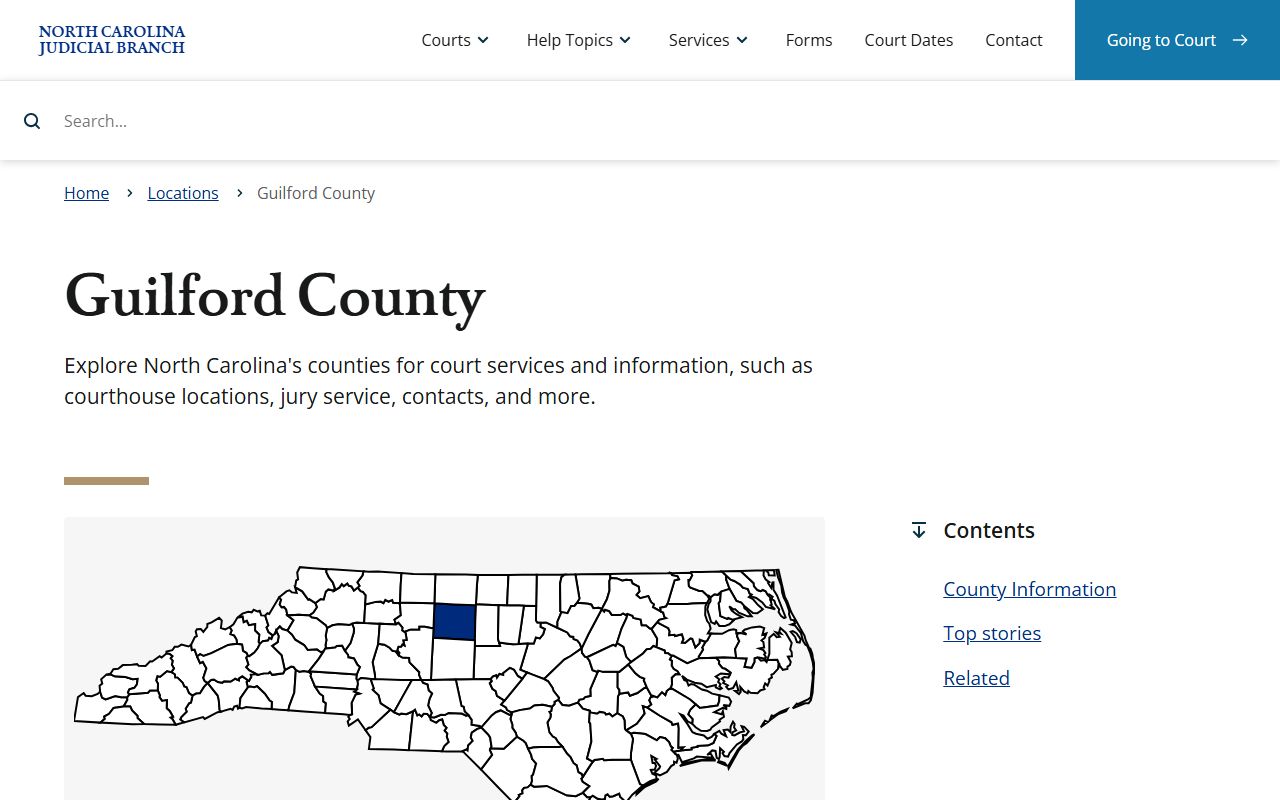
Guilford County has court functions in Greensboro and High Point. Use the courthouse tied to the case location or the clerk guidance from the Judicial Branch. The Judicial Branch cautions that people performing background checks should use the county clerk's office rather than treating Portal as a background-check product.
Guilford County Courthouse - Greensboro
201 S. Eugene St.
Greensboro, NC 27401
336-412-7300
Mailing address: PO Box 3008, Greensboro, NC 27402
Guilford County Courthouse - High Point
505 E. Green Drive
High Point, NC 27262
336-822-6700
Mailing address: PO Box 2434, High Point, NC 27261
The Judicial Branch Guilford County page identifies the county court location and related services.
Charges Filed After a Guilford Arrest
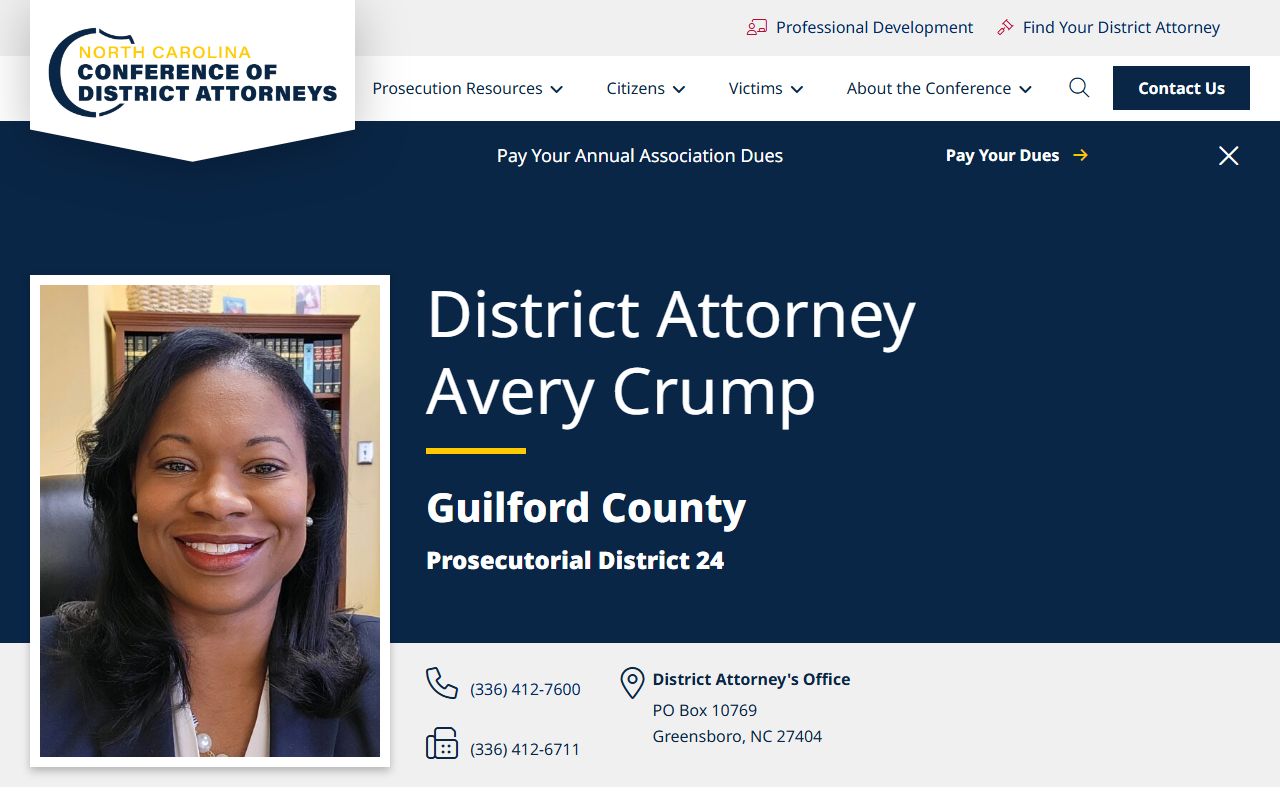
Jail charges are not always final court charges. The District Attorney may amend, reduce, dismiss, supersede, or formally file different charges as the case moves from arrest into court. In Guilford County, Prosecutorial District 24 is served by District Attorney Avery Crump. The DA's role is prosecution, not jail custody, which is why a P2C booking entry and a court case record can diverge.
| Document Type | Plain-English Role | Why It Matters |
|---|---|---|
| Complaint or magistrate process | Early accusation or process tied to arrest or initial charging. | May be close to the booking charge but can change later. |
| Information or prosecutor-filed charge | Formal charge filed by the prosecutor where allowed by procedure. | Shows the case the State is pursuing in court. |
| Indictment | Grand-jury charging document for felony matters when used. | Can supersede earlier arrest or complaint language. |
Guilford County Charge Status
Each charge can have its own status. A single arrest can produce several court counts, and each count may move differently. One charge may be dismissed while another remains pending or ends in a plea. Treat the status field as a snapshot and verify it through the court record or clerk when the result matters.
| Status | What It Means |
|---|---|
| Pending | The charge remains open and has not reached final disposition. |
| Amended or reduced | The prosecutor or court changed the charge from the original form. |
| Dismissed | The charge was ended without a conviction on that count. |
| Nolle prosequi | The prosecutor declined to continue that charge in its current posture. |
| Disposed | The charge has a recorded outcome, such as plea, verdict, dismissal, or other final court action. |
Bond After a Guilford County Arrest
Bond information may appear in both jail and court channels. P2C supports total bond amount and charge-level bond details, while the court record reflects hearings and judicial orders. North Carolina uses cash, surety, written promise, unsecured bond, secured bond, and other conditions depending on the case. A hold can prevent release even when a bond amount appears.
| Bond Type | How It Works |
|---|---|
| Cash bond | Cash payment is required under the court or magistrate order. |
| Surety bond | A licensed bondsman or surety posts the bond under North Carolina rules. |
| Written promise / PR | The person is released on a promise to appear if ordered. |
| Unsecured bond | No upfront money is paid, but money may be owed if court conditions are broken. |
| No-bond hold | Release by ordinary payment is not available for that hold or case status. |
Warrants and Arrest Court Records
Guilford County's Sheriff's services page has warrant information but no separate public criminal warrant search portal was located. The Sheriff's Office handles service of criminal summonses, arrest warrants, arrest orders, fugitive matters, subpoenas, child-support orders, and other criminal process. A person who believes a warrant may exist should contact the warrant or magistrate channel rather than relying on a web search alone.
| Channel | Location / Phone | Use |
|---|---|---|
| Greensboro Warrant Office | 201 S. Edgeworth St.; 336-641-2727 | Business-hours criminal process questions. |
| High Point Warrant Office | 507 E. Green Drive; 336-641-7907 | Business-hours criminal process questions. |
| Staff Duty | 336-641-3355 | Nights and weekends. |
| Court records | NC eCourts Portal or clerk terminal | Failure-to-appear and court-case status checks. |
GCSO Civil Process Search is a civil process lookup, not a criminal warrant database. Do not use it as an active criminal warrant list.
District Attorney After Arrest
Guilford County is in Prosecutorial District 24. The current District Attorney is Avery Crump, and the official district attorney profile describes the DA's core role as prosecuting criminal cases in District and Superior Courts, representing the State in juvenile proceedings, preparing criminal trial dockets, and advising law enforcement. The DA's office phone is 336-412-7600.
The official District Attorney profile is useful for understanding who controls prosecution decisions after booking. The jail can confirm custody; the prosecutor and court record show whether the arrest charge was filed, changed, dismissed, indicted, or resolved.
Charges vs Convictions
A charge is an accusation or formal count. A conviction is a final result after a plea, verdict, or other qualifying disposition. The difference matters for employment, housing, licensing, immigration, and personal decision-making, but casual web lookups are not a substitute for certified court records or legal advice.
| Charge | Conviction | |
|---|---|---|
| Stage | Accusation after arrest or filing. | Final adjudication by plea, verdict, or qualifying court action. |
| Proof | May be based on probable cause or filed allegations. | Requires the legal standard for conviction. |
| Record Meaning | Shows what was alleged or filed. | Shows the final criminal outcome on that count. |
Expunged Arrest Court Records
North Carolina expunction rules are separate from ordinary court lookup. N.C.G.S. 15A-145.5 provides expunction eligibility for certain misdemeanors and felonies. A person seeking to clear an eligible case should rely on the court process and any court order, then ask the originating agency how it handles records affected by the order.
| Sealed or Restricted | Expunged | |
|---|---|---|
| Public Visibility | Hidden or limited from public access. | Removed under a court expunction process when eligible. |
| How It Happens | By statute, court rule, or court order. | By court order under North Carolina expunction law. |
| Agency Follow-up | Ask the record custodian how restrictions apply. | Use the expunction order with the originating agency. |
Background Check Limits
The Judicial Branch warns that individuals performing background checks should use the county clerk's office, not Portal. Court records after a jail arrest can be useful for understanding a case, but casual search results may be incomplete, delayed, or misunderstood. Certified records, clerk searches, and legally compliant background-check channels are different from browsing public records.
Important: This site is not a consumer reporting agency and cannot be used for FCRA-covered screening decisions.